
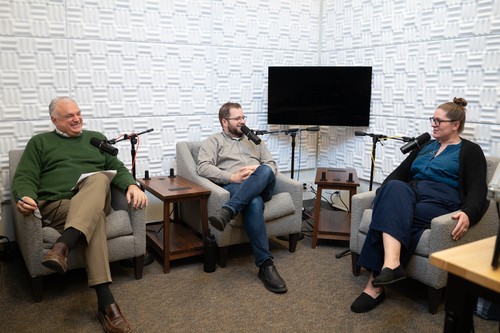
AMERICAN EVANGELICALS blends storytelling and free-flowing conversation to explore the varieties, similarities, and significance of evangelical Christians in American history.
Spanning the religious revivals of the 18th century to the cultural and political conflicts of the 21st, each episode is a conversation based on the historical research of its hosts, the deep scholarship on American evangelicals, and the lives of real figures who shaped the movement.
Hosted by three historians of American evangelicalism, discover how evangelicals have shaped and been shaped by the challenges of not just theology and belief, but by the same forces that have contributed to American society, from immigration to war, race, and economics.
This podcast is a partnership with the Lumen Center and STUDIO, both initiatives of the SL Brown Foundation.
Spanning the religious revivals of the 18th century to the cultural and political conflicts of the 21st, each episode is a conversation based on the historical research of its hosts, the deep scholarship on American evangelicals, and the lives of real figures who shaped the movement.
Hosted by three historians of American evangelicalism, discover how evangelicals have shaped and been shaped by the challenges of not just theology and belief, but by the same forces that have contributed to American society, from immigration to war, race, and economics.
This podcast is a partnership with the Lumen Center and STUDIO, both initiatives of the SL Brown Foundation.
PODCAST HOSTS

JOHN FEA is a historian who taught for 23 years at Messiah College in central Pennsylvania, where he was Professor of American History. He is currently a Visiting Fellow in History at the Lumen Center, an initiative of the SL Brown Foundation. He is the author of multiple books on American religion and politics, including Was America Founded as a Christian Nation? and Believe Me: The Evangelical Road to Donald Trump. John is a widely cited voice on the history of evangelicalism and its relationship to American politics, and his work has appeared in publications ranging from The Washington Post to Christianity Today.
DAN HUMMEL is the Director of the Lumen Center, an initiative of the SL Brown Foundation. He's a historian of American religion, focusing on theology, foreign relations, and evangelical culture. He is the author of Covenant Brothers: Evangelicals, Jews, and U.S.-Israeli Relations and The Rise and Fall of Dispensationalism: How the Evangelical Battle over the End Times Shaped a Nation. Dan brings to the podcast a particular interest in the intellectual and theological life of evangelicals and their international connections.
MAGGIE CAPRA is a visiting instructor in American history at Beloit College. Her research centers on the theological dynamics within evangelical and holiness communities, with a particular focus on questions of marriage, family, divorce, and gender in the 20th century. Her work recovers the stories of lesser-known figures whose lives illuminate the intellectual and spiritual history of the movement — including those marginalized or overlooked in the standard historical record. Maggie brings to the podcast a talent for narrative history and a commitment to telling the full complexity of the evangelical story.
DAN HUMMEL is the Director of the Lumen Center, an initiative of the SL Brown Foundation. He's a historian of American religion, focusing on theology, foreign relations, and evangelical culture. He is the author of Covenant Brothers: Evangelicals, Jews, and U.S.-Israeli Relations and The Rise and Fall of Dispensationalism: How the Evangelical Battle over the End Times Shaped a Nation. Dan brings to the podcast a particular interest in the intellectual and theological life of evangelicals and their international connections.
MAGGIE CAPRA is a visiting instructor in American history at Beloit College. Her research centers on the theological dynamics within evangelical and holiness communities, with a particular focus on questions of marriage, family, divorce, and gender in the 20th century. Her work recovers the stories of lesser-known figures whose lives illuminate the intellectual and spiritual history of the movement — including those marginalized or overlooked in the standard historical record. Maggie brings to the podcast a talent for narrative history and a commitment to telling the full complexity of the evangelical story.